Tuesday, October 19, 2010

CSA Share Week 21


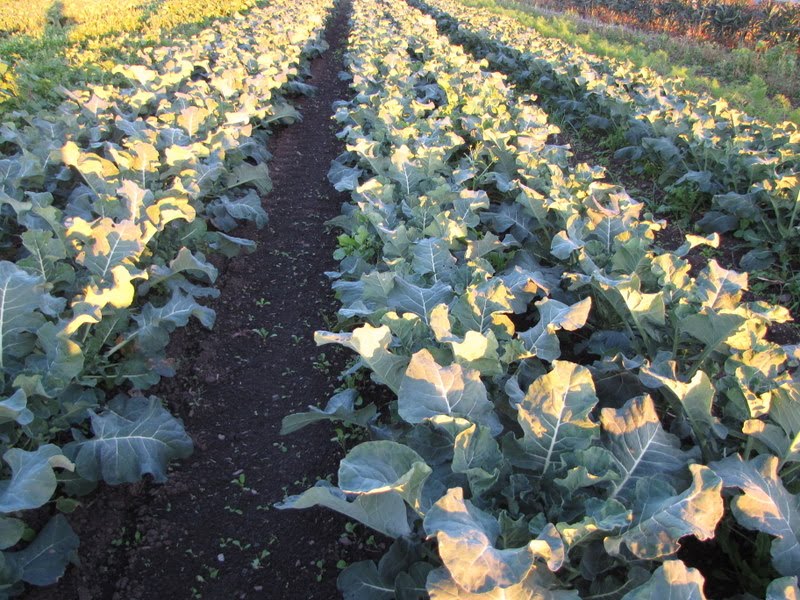
Caption: Weather extremes have stunted the farm’s broccoli crop, placing thousands of plants a few weeks behind schedule. Beautiful plants stand vibrant but with no edible buds in sight.


This week you’re seeing some fall favorites: parsnips and spinach. And we’ve tried to include as much that’s fresh from the field (versus storage crops) while we still have it. A sharp freeze any day now could kill off most of what still stands in our fields.

There are a few classic fall crops that we regret we just aren’t getting right now. Namely, broccoli. And cauliflower. And Brussels sprouts.

Their absence pains us as these are vegetables that we’ve been craving along with many CSA members and that we’ve put a lot of work into having this fall. All of these crops were planted in abundance and right on time late in the summer. Theoretically, they should be at their prime right now. But as soon as they were planted we hit the last of this summer’s extreme hot and dry spells. Two weeks’ worth. None of these crops thrive under such conditions. So they sat there dormant in the fields. The stretches of rain we’ve had haven’t helped either. Ten days without sun isn’t exactly an ideal growing scenario. So we’ve thousands of lusciously green leafy broccoli plants, cauliflower plants and Brussels sprouts without any “buds” to speak of. If we got some nice, consistent weather, maybe they’d bud up in a few weeks. But, basically, they’re well behind schedule, and there’s a good chance they’ll freeze before they come to fruition.

So, we work with what we have. Much to enjoy, just not everything we’d hoped, planned and planted for.


IN THIS WEEK’S SHARE:
1 bunch parsnips
½ pound spinach
14 ounces yellow wax beans
1 bunch fresh, baby onions (green tops edible)
6 ounces mesclun mix (for salad or for quickly wilting in olive oil)
1 bunch parsley
1 bunch Easter egg radish
1 head “freckles” Romaine lettuce (see note)
1 bunch dinosaur or Tuscan kale (or 3/4# sugar snap peas if not in your share 2 weeks ago)

___________________

Freckles Romaine:
The reddish-brown “freckles” on this week’s head lettuce aren’t a sign of disease or frost damage. The speckles are intended with this variety of Romaine lettuce. In a salad, we think they look festive. And for a Romaine, we love how tender this variety of lettuce can be.

____________________
Tip: If you have dill left over from last week, chop and blend with some sour cream, lemon zest and lemon juice and extra-virgin olive oil for a zesty dressing for the spinach (if eaten raw). Or drizzle over a salad of sliced radish and parsley leaves.

_____________________
PARSNIPS are a classic in stews, but they are also terrific roasted on their own. We often make this recipe developed by a friend, Amy Albert, for Fine Cooking magazine.
RECIPE: Crisp Roasted Parsnip Sticks We eat them like fries, sprinkled with a little malt vinegar.

or, add a little local maple sweetness with the following roasted parsnip recipe:

MAPLE-GLAZED ROASTED PARSNIPS
From Free Bird Farm

1 bunch parsnips, cut on a diagonal into 1/2-inch-thick slices
2 tablespoons extra-virgin olive oil
Kosher salt
2 teaspoons finely chopped fresh Italian parsley
1 ½ tablespoons pure maple syrup
1 tablespoon unsalted butter

Heat oven to 400°F. Toss the parsnips with the olive oil and a large pinch of Kosher salt in a bowl. Sprinkle with a large pinch of Kosher salt. Spread parsnips in single layer on rimmed baking sheet.

Roast parsnips 20 minutes. Turn and roast until browned and soft, 15 to 25 minutes longer. Remove the baking sheet from the oven and push the parsnips together into a loose pile with a metal spatula. Drizzle the parsnips with the maple syrup and dot with the butter. Toss to evenly coat with the syrup and butter. Transfer to a plate, sprinkle with the parsley and serve.

_______________________________________
At the farm, we had this for dinner last night, along with some gently crisped shallot slices and narrow strips of bell pepper (from last week's share) sauteed in olive oil. Great with some short-grain brown rice.

Quick Sautéed Spinach with Garlic Chips
From Free Bird Farm

4 peeled cloves garlic, very thinly sliced
3 tablespoons extra-virgin olive oil
½ pound spinach, washed and spun dry in a salad spinner
Kosher salt and freshly squeezed lemon juice to taste

Heat half of the olive oil a heavy, large skillet (we recommend cast iron) over medium heat. Add the garlic slices in a single layer and cook, stirring occasionally, until golden brown. Transfer to a small bowl and set aside.

Add the remaining oil and increase the heat to medium high. Add the spinach and cook, tossing frequently with a pair of tongs, until just wilted, about 3 minutes. Remove from the heat and sprinkle with lemon juice and Kosher salt to taste. Serve immediately with the crisp garlic “chips” sprinkled on top.

Wednesday, October 13, 2010

Share Week #20


We’ve reached that time in the season when the weather really has the final word. We could have a good variety of crops thriving until almost Thanksgiving or it could be pretty much a wrap within the next couple of weeks.

This past weekend we got our first frost, and it was a good zap.

We spent Saturday harvesting like mad—bringing in whatever we knew wouldn’t stand up to Sunday’s early morning frost. Some of this week’s share consists of that final picking.

Saturday was also spent covering those crops most vulnerable to frost, such as green beans and baby lettuce, with a soft, protective agricultural fabric (seen in pic).

The farm is still waterlogged from that unrelenting rain we had up until Thursday. Even in sloped spots, the fields are still wet and muddy. We simply got more rain than the ground could absorb. This makes the harvest extra challenging—because there’s often 2 pounds of thick, heavy mud clinging to the soles of one’s boots. (Those CSA members who made it to this year’s rainy day Open House know a little bit about what we’re talking about.)

We could now use some consistent sun and relative warmth so that the fall plantings that survived all that rain can grow. Nothing has been able to progress or grow in the last couple of weeks, which could short us of harvestable crops in these last couple weeks of the CSA season.

IN THIS WEEK’S SHARE
2 lbs. red potatoes
3 red onions
6 ounces mesclun mix
1 bunch carrots
1 bok choy
6 ounces arugula
1 red leaf lettuce
1 bunch dill
3 yellow onions
last-of-the-season bell peppers or green beans


______________________________
RECIPES:

Dill goes with a lot more than just pickles. Looking for an idea? Here are a couple that go with some of the veggies in this week's share too:

Carrot Soup with Dill PestoFrom Epicurious.com

AND

Creamy Potato Salad with Lemon & DillServes six.

This was adapted from a recipe by Molly Stevens in Fine Cooking magazine. The salad would be niced served over a bed of this week’s red leaf lettuce.

2 pounds unpeeled red potatoes, scrubbed (small potatoes left whole, medium to large ones cut into large chunks)
Kosher salt
¼ cup minced red onion
2 tablespoons chopped fresh dill
1/4 cup heavy cream, well chilled
1/2 cup mayonnaise
1-1/2 teaspoons Dijon mustard
1-1/2 tablespoons fresh lemon juice
2 teaspoons grated lemon zest
Freshly ground pepper

Put the potatoes in a medium saucepan, cover with water by an inch or two, add a large pinch of salt, and bring to a boil. Reduce the heat to medium, partially cover, and cook until the potatoes are tender, about 20 minutes. Test for doneness by spearing a potato with a thin metal skewer. It should penetrate easily into the center of the potato and then slide right out. If the skewer lifts the potato out of the pot when you withdraw it, continue cooking a little longer. Drain the potatoes and let them cool. You can drain them on a cooling rack set over or in your sink, which will avoid squashing the tender potatoes (as often happens with a colander) and also lets the potatoes cool quickly.

When the potatoes are at room temperature, cut them into 3/4-inch chunks and put them in a mixing bowl. Add the onion and fold gently to distribute; set aside.

In a small bowl, whisk the cream until frothy but not at all stiffened. Whisk in the mayonnaise and mustard. Add the lemon juice, zest, 1/2 teaspoon salt, and pepper to taste. Pour the dressing over the salad and fold it in with a rubber spatula. Taste for seasoning. Serve, or cover and chill for up to a day.


A great fall recipe for lunch or a light dinner (maybe with the carrot soup?) that makes use of this week's arugula: Open-Face Brie, Apple, and Arugula Sandwiches

OR

Pasta Salad with Arugula, Feta & Sun-Dried Tomatoes, by Tony Rosenfeld, Finecooking.com

And here's something to try with this week's bok choy...

Salmon "Bulgogi" with Bok Choy and Mushrooms
Bon Appétit | June 2008

Tuesday, October 5, 2010

CSA Share Week 19


After harvesting the CSA share and emptying out some sand bags (used to hold down row covers) on Monday, one of Free Bird Farm’s staff is ready to shower and put his feet up (boots off, of course). It sure is wet.

There’s a lot of mud on our boots. Here at the farm, we don’t have sidewalks, paved roads around the fields or even a paved driveway. There’s some gravel and a whole lot of exposed dirt. And after the 6+ inches of rain we got late last week, it seems like it’s all just mud.

As it rained and rained and rained Wed., Thurs. and Fri., there was still a large harvest to tend to. So everyone worked, moving inside to clean onions or to handle other tasks when the rain fell just too hard. And now everyone is working through the storm’s aftermath, trudging through the fields with heavy hunks of mud clinging to boots and mud stained through the knees of one’s pants, smeared on sweatshirts, splattered on hats. It’s a mess.

It’s still a little early to assess the damage of the excessive rain that dumped on the fields last week. It seems to have ruined some heads of lettuce that were due in a couple of weeks. And there’s even more rain in store this week. Time will reveal what crops were able to hold up and which are going to perish from the excessive water.

(P.S. There are quite a few new or less familiar items in this week’s share, so we included many “primers” and recipes this week to hopefully inspire you.)

______________________
In this week’s share:
2 delicata squash
1 pound Tongue of Fire fresh shell beans
¾ pound green beans
1 head of escarole
6 ounces of arugula
1 bunch Tuscan or “dinosaur” kale
1 head of Romaine lettuce
2 kohlrabi or ¾ pound peas*


*We had limited availability of both these crops this week. Our hope is there will be enough next week so that whoever received one gets the other.
_________________________________

“Rusty” green beans
You might notice reddish-brown markings on some of this week’s green beans. This “rust” basically shows up on the beans in wet and cool temperatures (like we’re having). They are still good to eat, but… they are not going to hold as long as usual in your refrigerator. So eat sooner than later.

ROASTING DELICATA SQUASH
This is a great weeknight squash. Perhaps the simplest way to cook it: slice it in half lengthwise, scoop out the seeds, brush cut sides with oil, sprinkle with coarse salt, and roast on a heavy duty sheet pan with raised edges in a 375 degree oven. At Free Bird, we like to start the roasting process cut-side down until it’s nicely caramelized underneath where the flesh touches the pan. Flip once it’s richly golden brown to finish cooking through (if the squash flesh is not already fully tender when pierced with a fork). Sorry—we’re guessing on the time: about 30 minutes? Check after 20 minutes, just to be on the safe side. To serve, rub the flesh with butter and, if you like, lightly drizzle with maple syrup.


REVISITING SHELL BEANS We’re always glad to see an extra basket of these beans in the farm’s walk-in cooler. As a family we’ll sit together for a good long while (you’d never believe a 2-year-old could sit at such a task for so long) and gently pry open the shells, popping the colorfully mottled beans into a bowl or large cook pot. Sometimes we have a contest—which team can shell the most beans at once. Most of the time we sit quietly, focused on the group task. Whatever we don’t eat, we freeze in zipper-locked bags and enjoy through the winter in stews, pastas or with sautéed greens. These beans are creamy in texture and mildly nutty in flavor, similar to a cannellini bean.

TO COOK THE FRESH SHELL BEANS: place the shelled beans (pods discarded) in a pot of water. Add a bay leaf and any aromatics you have on hand, such as a chopped carrot, parsley stems, or an onion, and bring to a boil. Reduce to a gentle simmer, stirring occasionally, until the beans are creamy in texture all the way through, about 30 minutes.

These beans would go great with this week’s kale. Strip the stems from the kale and sauté it briefly in extra-virgin olive oil in a 12-inch skillet over medium-high heat. Add a clove of minced garlic at the end of cooking, turn off the heat and toss in the (cooked beans). Season with Kosher salt and freshly ground black pepper to taste. Serve with freshly grated Parmigiano Reggiano.

OR try the beans with this recipe for White Bean and Escarole Soup with Garlic (perfect for this cool, rainy week we’re having).

OR make your own vegetable soup, like a minestrone, with the shell beans, green beans, kale and, if you have left over from last week, butternut squash and carrots. Include a can of tomatoes if you have that in your pantry.


_________________________
Primer on Kohlrabi
If you’re wondering what the ogre-like turnip-looking vegetables are in this week’s share (white or purple), they’re kohlrabi. Actually a cabbage, kohlrabi has a bulbous stem that grows just above ground. Its leafy stalks shoot upward from the bulb. Both parts can be eaten but are best cooked separately. (*Kohlrabi can be prone to splitting during growth. This happened to some of our white ones in this week’s distribution. We found they are still just as tasty—just a little unusual in appearance.)

Kohlrabi has a crisp, juicy texture, like an apple or water chestnut. Peel the thick, outer skin off, and inside you’ll taste an earthy sweetness reminiscent of cabbage with a hint of bite like a radish.

Kohrabi is often used shredded or thinly sliced in a slaw or salad, such as in this recipe for Kohlrabi-Radish Slaw with Cumin and Cilantro. (If you don't have radish on hand, thinly slice the kale or escarole to substitute. Or use cabbage.) If cooked – sautéed, roasted or added to a braise or stew—kohlrabi retains some of its crunchy texture, but the flavor mellows quite a bit.

To store, cut the leafy stalks off the bulbs and refrigerate the bulbs separately in a sealed bag or container. If stored properly, the bulbs can last a few weeks.

Monday, September 27, 2010

CSA Share Week #18


A CSA member recently asked us how we determine what’s in a share from week to week. We thought this was a good question and worth sharing our answer with everyone.
There are a lot of factors we weigh when we determine a share each week:
• Firstly, we try to distribute to members what is most fresh in our fields;
• We also try to distribute what we have enough of each week for all members so that most weeks everyone gets the exact same share. If we're short something, we make sure those who get something else get something similar and of comparable value. For example, recently we didn't have enough escarole for all members, so one group got kale instead (which we had some of but not enough for everyone). Similarly, we recently didn't have large red and yellow bell peppers for everyone, so one distribution group got smaller peppers but more of them (3 versus 2).
• We try to make sure that the value of a share is more than $20 (Upstate NY prices)—knowing that depending on the stage of the season some weeks might not be quite that and most weeks it’s comfortably more than that. This season we have been fortunate to consistently meet this standard each week starting at the very beginning of the season. For example, this week’s share we calculate to be worth slightly more than $23 if purchased at one of our Upstate farmer’s markets.
We should also note that being in a CSA means you may not always get that value--depending on how the season turns out; if a farm loses 70% of their crop to hail (and I've heard of this happening), the members also suffer a loss in their shares. That's the "shared risk" part of being in a CSA; you’re willing to hang in there with the farm through thick and thin.
• On the flip side, we also try to make sure each week’s share isn’t too large. Distributing more produce than members can use in the course of a week is an all too common way a CSA can drive off members the following year. So we try not to overwhelm members while at the same time making sure they feel like they are getting an ample share each week.
• Lastly, we try to minimize too much repetition with certain vegetables--so if you've had eggplant 2 weeks in a row, we try to avoid including that crop for at least the following week. Granted, with vegetables like salad greens or onions, which people regularly eat or use to cook, we aren’t so hesitant to offer repetitively. We also try to make sure each week’s share is well balanced in terms of the makeup and diversity of the vegetables in the share. For example, if we include something out of the ordinary (like the Asian greens in this week) we try to make sure it’s balanced by plenty of more commonplace vegetables.
It's tricky business—determining what's in a share each week. We put a lot of thought into it. Often we stress about it—wanting to make sure members get the best of what we have, a nice variation of items, and at a value better than if they were to buy from an organic grower at a farmer's market or at a natural foods grocery store like Whole Foods. Fortunately, this has been a pretty good season so far. But, ultimately, we can only think out, debate and assess a share list each week according to what nature permits. We’d love to be including collards, broccoli, head lettuce and kale this week as we’d planned, but these were crops affected by this season’s weather extremes. But there’s still a good chance you’ll see these items before the season is over. And on the flip side, you’re seeing potatoes—a crop we had very little of in 2009 because of last year’s infamous late blight.

IN THIS WEEK'S SHARE:

1 butternut squash
1 bunch Swiss chard
1 ½ pounds beets
1 bunch cilantro
1 red onion
red bell peppers
1 bunch leeks
1 bunch mixed Asian greens (mizuna, tatsoi, Japanese red mustard greens)
1 ½ pounds all-purpose white potatoes


___________________________________________
RECIPES
___________________________________________

BUTTERNUT SQUASH with GINGER and CILANTRO
Adapted from a recipe by Lori Longbotham in Everday with Rachel Ray, Nov. 2009

2 pounds butternut squash, peeled and cut into 3/4-inch cubes
2 tablespoons vegetable oil, such as safflower or canola
3/4 teaspoon ground coriander
Kosher salt and freshly ground black pepper
¼ finely chopped crystallized ginger
¼ cup cilantro leaves

Directions: Preheat the oven to 450°. In a large bowl, toss the squash with the oil, coriander, 1/2 teaspoon Kosher salt and 1/4 teaspoon pepper. On a large baking sheet, arrange the squash in a single layer and bake, turning occasionally, until tender and golden-brown, about 30 minutes.

Transfer the squash to a serving bowl and toss with the crystallized ginger and cilantro.

_____________________________________
CREAM OF RED PEPPER AND POTATO SOUP
This is a recipe from another one of the farm’s favorite cookbooks—“One Potato, Two Potato” by Roy Finamore with Molly Stevens. There’s hardly a recipe in this book that doesn’t make you want to cook. This recipe conveniently makes use of a few items in this week’s share.

1 tablespoon olive oil
1 pound red bell peppers (2 to 3 peppers), cored, seeded and chopped into 1-inch pieces
1 cup chopped leeks (white and pale green parts)
2 garlic cloves, minced
½ teaspoon sweet paprika
Pinch of cayenne pepper
Coarse salt and freshly ground black pepper
1 pound waxy potatoes, peeled and cut into ½-inch chunks
1 cup light cream

Heat the olive oil in a wide soup pot over medium heat until it slides across the pan. Add the bell peppers, leeks, garlic, paprika, cayenne, and salt and pepper. Reduce the heat to medium-low and cook gently, stirring from time to time, until the vegetables begin to give up some of their liquid but are not at all brown, about 5 minutes. Add the potatoes and continue to cook for another 5 minutes.
Add 4 cups water, cover partway, and bring to a boil. Reduce the heat to a simmer and cook until the vegetables are very tender, 20 to 30 minutes.
Let the soup cool for 5 minutes, then work it through a food mill to eliminate all pepper skins (farm’s note: if you don’t have a food mill, press through a colander with a large rubber spatula). Stir in the cream and then strain the soup through a fine mesh sieve. (Skipping this last step will give you a soup of equally fine flavor but with a much less luxurious texture.) Rinse out the pot and pour the soup into it. Return the soup to the heat and bring it to a simmer. Taste for seasoning and serve warm.

_________________________________________
SIDEBAR: EGG FRESHNESS
Ever wonder how fresh our eggs are? Well, we can’t tell you exactly which day the particular eggs in your carton were laid, but we can say that all of the eggs that go to our Tuesday CSA members were laid some time between Friday and Monday. (Saturday distribution members' eggs were laid any time between Tuesday and Friday.) So that makes the eggs anywhere from 1 to 4 days old when they arrive at distribution (they're kept refrigerated during that duration). A study from the University of Illinois that found supermarket eggs ranged from being 7 to 45 days old, with the average age being 16 days.
________________________________________

Tuesday, September 21, 2010

CSA Share Week 17


This Thursday is the first day of fall, and we've enjoyed spotting the signs
of its arrival as we walk around the farm with our kids. Acorns are dropping
to the ground. Goldenrod is in flourish. Milkweed pods are beginning to
unfurl, their fairy-like seeds loft into the air. Pheasant are popping in
and out of hedgerows. Monarch butterflies seem to be taking their last sip
of nectar from clover buds before migrating south. The green of the pasture
is losing its vibrancy and, oh yes, some leaves have just begun to turn
color.

The region received its frost warning for tomorrow morning (Tues.) north,
south, east and west of us. We're holding our breath that we truly are
spared. In the same week we're expecting 80-degree weather. These are the
kinds of days when everyone starts work in sweatshirts and knit caps and
ends the day in short sleeves.

This week at the farm another sure sign of autumn's approach can be
witnessed inside our barn. We're cutting down, trimming, cleaning and
packing up the garlic crop-much of which will go with us to the Hudson
Valley Garlic Festival
this weekend in Saugerties, NY.

If you are looking for something to do and either love garlic or love
festival-style amusement, this is quite an event to attend. There are dozens
of garlic growers like us, peddling garlic, braids and other
garlic-related products. There are braid-making workshops. There's music.
There are craft booths. And, for those who dare, there's garlic ice cream.
It's a big event (thousands attend), and, if you go, we don't recommend
making plans that evening with anyone who hasn't attended the festival as
well. Because if you succumb to the standard conduct of those attending the
festival, you'll be grazing on raw garlic samples all day as if it's candy.
You'll learn to tell the difference between one variety's level of pungency,
another's heat, another's sweetness...—until all that garlic ultimately
burns out your taste buds for the day.


In this week's share:
1 ½ pounds red potatoes
8 ounces (1/2 pound) spinach
6 ounces salad mix
1 bok choy
1 bunch carrots
1 bunch green onions
1 bunch mixed radish (pink, purple, red, white)
1 bulb garlic


*******Special Request from the Farm:*******
Maybe some of you have heard of Cookies for Kids ' Cancer, a 501 (c) nonprofit some special friends of the farm started after their son was diagnosed with cancer at the age of 3. The organization raises funds to support research
for new and improved therapies for pediatric cancer. Cookies for Kids'
Cancer was recently selected by the Jimmie Johnson Foundation (Nascar
Driver- Lowe's Team) as a winner in its Samsung Helmet of Hope Program. The
13 chosen charities are now in a popularity contest to win an additional
$20,000 grant. Plus, the winning charity will receive a great deal of
publicity and awareness courtesy of the most successful driver in Nascar. If
you can, please take a moment to vote for Cookies for Kids' Cancer at this
link. You can vote from every computer you can find and depending on your internet connection, from different browsers on the same computer.
Our friends' son, Liam, age 6 now, is still battling neuroblastoma.

Thank you for considering this.
__________________________________________________________________
RECIPES

Stir-Fried Bok Choy with Garlic, Ginger, and Scallions
by Susie Middleton, from Fine Cooking magazine

A simple, four-ingredient sauce makes a perfect finish for the intriguingly sweet and bitter flavor of this stir-fried Asian green. You can use mature or baby bok choy for this recipe.

Serves three to four.

1-1/4 lb. bok choy (about 1 large, 2 medium, or 5 to 6 baby)
2 Tbs. oyster sauce (preferably Lee Kum Kee brand)
2 Tbs. lower-salt chicken broth
1 tsp. cornstarch
1/4 tsp. Asian sesame oil
2 Tbs. peanut oil
Kosher salt
4 oz. scallions (8 to 10 medium), white and light-green parts only, cut into 3-inch lengths and halved lengthwise if thick
2 large cloves garlic, peeled and thinly sliced
One 1/2-inch square of ginger, peeled and cut into thin matchsticks


To prep mature bok choy, separate the leaves from the stems by slicing the bok choy head crosswise at about the point where the leaves begin to spread out. Cut the leaves into lengthwise strips 1 to 1-1/2 inches wide. Quarter the stem end lengthwise and remove any inner leaves, putting them with the leafy tops. Slice the stem quarters crosswise into pieces about 3/4 inch thick. Rinse and dry the stems and leaves separately. (If using baby bok choy, simply cut the heads lengthwise into 3/4-inch-wide pieces or wedges.)

In a small bowl, combine the oyster sauce, chicken broth, cornstarch, and sesame oil. Whisk well to dissolve the cornstarch.

In a 12-inch nonstick stir-fry pan, heat the peanut oil over medium-high heat. When the oil is hot, add the bok choy stems and season with 1/8 tsp. kosher salt. (If using baby bok choy, add all the pieces now and skip the step of adding the leaves later.) Cook, tossing frequently with tongs, until the stems are pliable and lightly browned, 5 to 6 minutes. Add the scallions, garlic, and ginger and cook, stirring constantly, until the aromatics are tender, fragrant, and starting to brown, about 2 minutes. Add the bok choy leaves and 1/8 tsp. salt. Using tongs, toss until the leaves are completely wilted and integrated with the stems, 1 to 2 more minutes.
Remove the pan from the heat, and using a heatproof spatula, stir the sauce and quickly mix it with the vegetables in the pan. As soon as the sauce thickens and has coated most of the vegetables (a few seconds), transfer to a platter and serve immediately.

_________________________________________________________
Traditional Creamed Spinach
From Wholefoodsmarket.com
Serves 6

Ingredients
About 3 pounds fresh spinach
3 tablespoons unsalted butter
1 tablespoon chopped garlic
3/4 cup small (1/4-inch) diced yellow onions (about 1 small onion)
3/4 cup heavy cream
1/2 cup grated parmigiano-reggiano cheese
Pinch ground nutmeg
1/2 teaspoon salt
1/4 teaspoon ground black pepper

To prepare spinach, first remove any unwanted stems or brown parts. Rinse leaves several times in cold water until all the dirt has been rinsed off. Drain spinach but leave some water clinging to spinach leaves.

Heat a large pan over medium-high heat and add wet spinach. (This step may need to be done in batches.) Turn spinach frequently with a pair of tongs as it cooks. Once it is wilted, remove from the pan and place in a strainer and squeeze out as much liquid as possible. (This step is very important.) Transfer drained spinach to a cutting board and chop coarsely. Set aside.

Meanwhile, melt butter in a saucepan over medium heat and add garlic and onions. Cook until onions are translucent and soft (about 10 to 15 minutes).
Add cream, parmigiano-reggiano, nutmeg, salt and black pepper and continue cooking until it is reduced a bit (about 5 minutes).

Add spinach to cream and mix well. Continue to cook until cream has almost completely been absorbed and dish is thick and creamy. Remove from heat and serve.

Tuesday, September 14, 2010

CSA Share Week 16


This Sunday the farm held its open house for CSA members. The forecast was for showers after 2 p.m. “Good enough,” we thought. It wasn’t going to be a lovely, sunny day, but at least it would stay dry for the bulk of everyone’s visit. Or so we thought.
Cars began rolling in at 10 a.m., just as it curiously began to start drizzling. “Maybe this will pass by. A quick shower,” we said to ourselves, holding fast to positive thinking. By the time the first tour was scheduled and about 30 people had arrived, the rain was pouring down. We sought shelter in the barn. Not such a bad place to start. The 200-year-old barn is a point of conversation in itself. So were the thousands of garlic bulbs hanging in the barn basement. And, seeking more cover, we moved to our largest greenhouse, were there was plenty to discuss and show there. After all, how many people have seen lettuce when its leaves are the size of one’s fingernail?
Eventually, we could stall no longer. The rain was pouring down, and no one seemed anxious to venture out to see our veggie fields. Hanging out under the 20 x 30 foot tent we’d rented wasn’t even desirable. It was a raw, wet day. So, thank goodness for our big, old farmhouse. Everyone packed into our 30-foot-long kitchen. We spread out a wonderful variety of food brought by members and provided by the farm, brewed some coffee, and simply got to know one another. It was great.
By the time lunch was over, the rain had subsided and we trekked out to see the main working part of the farm including the brooder, which presently houses about 300 two-week-old chicks, our primary vegetable fields, the new irrigation pond, and the hens out on pasture looking more than a little soggy.
It wasn’t quite the day we’d planned. We had activities planned that never happened—corn stalks in a back field ready to be cut down and bunched for members who might want to make door (or apt.) decorations, and a winter squash crop ready for harvest. But after accumulating a few pounds of thick mud on the bottoms of one’s shoes touring the farm, no one was itching to hike to the back of the farm where those crops lay wet and waiting.
We are so grateful to all those who came. It was a wonderful mix of members—coming from as close as across the street to as far as New York City and even Connecticut. We even had one member catch a red-eye flight back from L.A. to make it to the farm (thanks Ariel!). It was a treat for us to take a day off from our usual work and meet or better get to know some of the CSA members. (The bonfire the night before with campers was a highlight as well.) Again, to all, thanks!

________________________________________________
IN THIS WEEK’S SHARE:

1 bunch leeks
Mixed bell peppers
1 bunch cilantro
7 ounces spicy lettuce mix
¾ pound (12 ounces) edemame
6 ounces baby salad mix
1 watermelon
1 red onion


__________________________________________________
TIPS & RECIPES

This week’s spicy mixed greens are a combination of Mizuna, Red Russian kale, Komatsuna, Red Giant mustard, and Tatsoi. It’s suitable for a cold green salad with sliced red bell peppers or fall pears or for briefly wilting or stir-frying in hot oil with the week’s leeks. The spicy profile makes it well-suited to the following salad dressing adapted from one of the farm’s favorite cookbook sources for inspiring salads: Lettuce in Your Kitchen by Chris Schlesinger and John Willoughby(© 1996, William Morrow and Company).

Dressing #1:
1 1/2 stalk lemongrass, roughly chopped
1 tablespoon minced fresh ginger
1/3 cup white vinegar
1/3 cup water
1 tablespoon plus 1 teaspoon sugar
1 tablespoon plus 1 teaspoon neutral-tasting vegetable oil, such as peanut, sunflower or safflower oil
1 tablespoon plus 1 teaspoon soy sauce
1 tablespoon plus 1 teaspoon fish sauce (optional)

In a small saucepan, combine the lemongrass, ginger, vinegar, water, and sugar and bring to a boil over high heat. Reduce the heat to low and simmer until you have about 1/3 cup liquid, after about 35 minutes. Remove from the heat and strain, discarding solids. Add the sesame oil, vegetable oil, soy sauce and fish sauce (if you want) and mix well.

OR… if you cannot easily find lemongrass, this sesame dressing, also from Lettuce in Your Kitchen, is quick and uses more readily available ingredients.

DRESSING #2
Combine:
¼ cup olive oil
1 tablespoon sesame oil
¼ cup rice wine vinegar
2 tablespoons soy sauce
1 teaspoon minced garlic
1 teaspoon minced fresh ginger
Pinch of dried red pepper flakes
Salt and freshly cracked black pepper to taste

A nice addition to the greens would be grilled or sautéed chicken. Or, if wilting the greens, drizzle with the soy sauce and sesame oil dressing (above) and serve over sticky white rice or brown rice with thinly sliced red pepper and strips of cooked egg (beaten and left to set in the pan, like an omelet.)

What’s edemame? It’s a fresh soy bean. And don’t let its fuzzy exterior fool you. Inside the pods are nutty little beans that make a great snack, appetizer or side dish. They’re easy to cook and fun to eat. Not sure how to cook edemame? It’s as simple as cooking pasta. We recommend going to wikipedia.com and searching “how to cook edemame.” There are both instructions and a video.

Monday, September 6, 2010

CSA Share Week 15


This time of year most home gardeners put away their shovels and hoes. They enjoy what their gardens might happen to yield. Otherwise, what’s done is done. But after the last couple weeks of yo-yo weather we’ve had here, even those stick-it-out-‘til-the-bitter-end gardeners are feeling left with little choice but to call it quits.
While we’ve had a summer full of weather extremes, the latest two episodes were rough. It started two weekends ago when we had 6 inches of rain in about 24 hours. A state of emergency was declared in our valley because creeks and rivers were overflowing, making some roads impassable. The end result of that here on the farm wasn’t so great either. Certain low-lying fall plants simply drowned.
Next came the heat. Seven days of 90-plus degree hot, humid weather. No matter the crop, plants struggle in that kind of intense, sustained heat. Some just don’t make it. A lettuce crop we’d hoped to be harvesting right now (as we’re surely hankering for a head of lettuce) bolted. This happens when it’s too hot. The lettuce shoots up seemingly overnight to take on a cone-like shape and a bitter taste. There’s nothing to do but till it under.
By late Friday the cool air most elegantly arrived, and we’ve found ourselves thankful to be starting the day in long sleeve shirts.
Despite that fall feeling in the air, we’re still looking forward. It’s evident in our greenhouse, well-stocked with young, growing plants. We’ve newly prepared seed beds in the fields where we’re planting more arugula, salad greens, radish, etc. And in our basement a few “speed trays” of seedlings (pac choi and radicchio) are coming to life under grow lamps. So even though it might feel like we’ve plummeted into autumn, we’re banking on there still being time to keep growing some quick-to-grow, cool tolerant crops. It’s always worth a shot. How much time will we have? Well, we’re afraid that’s up to our friend Jack Frost.

_______________________________
In this week’s share:
1 watermelon
1 1/2 lbs Yukon Gold potatoes
6 ounces arugula
8 ounces (1/2 lb.) shallots
1 pound beets (no greens)
1 head escarole
2 bell peppers
1 eggplant
1 garlic


A note on this week’s eggplant:
Like fair-skinned people, light-colored vegetables can suffer from intense sun, of which we’ve recently had plenty. You may notice it in this week’s share with one of the two varieties of eggplant. With the round-ish Rosa Bianca eggplant, which has violet and white streaks, some of the skin has begun to take on a yellow hue. Don’t be turned off by this. It’s simply a “sunburn” and doesn’t affect the quality or taste of this Italian heirloom variety known for its creamy, mild flavor.
Similarly, we’ve heard a number of people at our farmers’ markets recently ask how to tell if an eggplant is ripe. If it’s firm and the skin smooth and glossy, it’s good. It doesn’t matter what size the eggplant is. And if your eggplant sits in your refrigerator and begins to take on that puckered look, don’t feel like you have to throw it out. It’s simply losing moisture. In our experience, it has to look rather withered before it’s unusable.

An advisory on last week’s “sweet” hot peppers.
Some CSA members received classic bell peppers in their share. Others received fire engine red, long, tapered peppers. We’d bit into the tips of a few before packing this variety up to make sure it was sweet. Yes, they tasted sweet and refreshing. Then, this weekend, when Maryellen was working at a farmer’s market, a customer asked if the tapered red peppers were sweet. Indeed, she thought, and she bit valiantly into a tip of one to prove it to the customer. Yes, it was sweet. Then one of our wise-beyond-years staffers suggested she bite into the pepper at the top. Holy hot pepper. The burn was intense. The staffer, who happens to eat 2 or 3 jalapeños a meal, got a good chuckle out of it. But we’re left a bit stumped, as we don’t recall ordering any hot red pepper seed (will need to dig into our records to be sure). And we’re remiss, as we hate to think how many CSA members used their “sweet” pepper only to find it was anything but. We ran another little taste test today, and were amazed to find that if you never come into contact with the seeds, there is no heat in the flesh of this pepper. But take the top of the pepper and roll it back and forth between your palms to press the seeds into the pepper and you’ve got yourself one heck of a hot pepper.

***Our apologies to anyone who was taken by surprise like we were.***
______________________________________________
RECIPES

Grated Beet and Carrot Salad
Instead of giving CSA members a recipe for roasted beets back in July when no one could even think of turning on their oven this summer, we should have shared this “recipe” for grated beet and carrot salad from Chocolateandzucchini.com. It’s more of a roadmap than a recipe. The author includes a long list of options, so that you can easily create your own version based on what you have on hand in your kitchen (maybe some parsley left over from last week’s share?)


What’s for dinner at the farm? At Free Bird Farm, we always try to make 1 dinner a week that primarily uses ingredients going to CSA members. Sometimes you read about them in recipe form (i.e. last week's turnip and parsley salad). Sometimes we share the idea because it's simple enough that we believe you can take the concept and run with it to your liking.
Last night (Mon.) we built a sandwich off the grill with roasted bell peppers, a fistful of arugula, grilled lamb sausage, goat cheese, balsamic vinegar and some fresh garlic minced to a paste (the garlic probably would have been a little less assertive if it had been roasted and, surely, this would have been just as satisfying with grilled eggplant slices instead of the sausage). Everything was pressed between a couple slices of rustic bread brushed with olive oil and toasted on the grill. We admit that we sliced a tomato and added that in too (not in this week’s share, we regret; the crop is losing steam). We also had some raw carrots on the side.


Mustard & Rosemary Roasted Potatoes
Adapted from a recipe by Molly Stevens for Fine Cooking magazine

These potatoes start out looking very wet, but the mixture cooks down to leave the potatoes crisp, crusty, and tangy.
Serves four.

¼ cup Dijon mustard
3 tablespoons cup olive oil
2 teaspoons dry vermouth or other dry white wine
1 large clove garlic, minced
2 teaspoons chopped fresh rosemary
¾ tsp. coarse salt
Freshly ground black pepper
1 ½ pounds Yukon Gold potatoes, cut into 3/4- to 1-inch dice

Heat the oven to 400°F. In a large mixing bowl, whisk together the mustard, olive oil, vermouth, garlic, rosemary, salt, and pepper. Add the potatoes and toss to coat. Dump the potatoes onto a large rimmed baking sheet and spread them in a single layer. Roast, tossing with a spatula a few times, until the potatoes are crusty on the outside and tender throughout, 50 to 55 min. Serve hot.