Tuesday, June 28, 2011

CSA Week #4


CSA members Scott Norton and Andrea Lacey harvest garlic scapes.

Thanks to all those CSA members who came Sunday to help out and harvest the last of the garlic scapes for this week's share! We enjoyed having visitors. For those of you who couldn't make it but would like to visit the farm, our Open House for CSA members is scheduled for Sunday, September 18.


IN THIS WEEK's SHARE:
1 bunch carrots
1 bunch basil
3/4 pound sugar snap peas
1 unit of broccoli (1 large head or 2 small bunched together)
3/4 pound garlic scapes
1 head of lettuce
1 bunch cilantro
1 bunch radish
1 bunch green onions

Tuesday, June 21, 2011

2011 CSA Season- Week 3


Letter from the Farm. Finally, we had a week of normal growing weather. We welcome hot, sunny days balanced out by occasional rain showers. When we recently had an overnight rain that was followed by a bright, warm day, Ken aptly commented, “You can practically hear the plants growing today.”
We are still trying to catch up from four weeks lost to bad weather in April and May. We continue to plant seeds and transplant from the greenhouse in between harvesting for the CSA and a couple of farmers markets.
Our plants are popping up and looking very healthy in most cases, yet so are the weeds. So now we begin the summer long project of weed pulling and tractor cultivation to eliminate as many weeds as possible. Part of being organic is that we never kill weeds with petrochemical “herbicides.” We remove them by hand or with mechanically.
On that note, we can ALWAYS use help with weed control. So for all those coming to volunteer on Sunday, we surely have work for you that can help the farm immensely! If you have not RSVP’d and would like to come, please do so asap. If you’ve never pulled weeds before, it requires no special skills and can be pleasantly meditative and extremely rewarding. Sometimes, at the end of the day, we’ll go out and pull weeds just because it can feel therapeutic.
We know it’s a hike for many to get here, but we really look forward to seeing those of you who can make it on Sunday.

-Ken & Maryellen


IN THIS WEEK'S SHARE:
¾ pound garlic scapes
1 bunch red Russian or Toscano kale
.35 pounds (6 1/3 ounces) Salad Mix
1 bunch baby turnips with (edible) greens
1 bunch beets (with edible greens)
Escarole or bok choy (whichever you did not get last week)
1 bunch Swiss Chard


GARLIC SCAPES. Those curly-cue shoots in this week’s share are garlic scapes (see pic above). They’re a flowering shoot that gets snapped off the garlic plant shortly after they appear so that the plant’s energy stays focused on developing a large, healthy bulb underground. Snap a scape in half, and you’ll recognize the bright aroma of early-season garlic. Scapes store really well (refrigerate in a sealed bag, and they’ll hold for at least a couple of weeks). Use them chopped or minced in whatever you’d normally use garlic. You can sauté or stir fry. Grill whole. Chop and add to pasta, salad, eggs… It’s incredibly versatile. Have fun experimenting with it on your own or in this pesto recipe—which would be great with pasta, especially a filled pasta, or as a spread on a sandwich.

RECIPE: Garlic Scape PestoAdapted from A Mighty Appetite blog by Kim O’Donnell, published online by The Washington Post

For ½ pound short pasta such as penne, add about 2 tablespoons of pesto to cooked pasta and stir until pasta is well coated.

1 cup garlic scapes (about 8 or 9 scapes), top flowery part removed, cut into ¼-inch slices
1/3 cup walnuts
¾ cup extra-virgin olive oil
¼-1/2 cup freshly grated Parmigiano Reggiano
Kosher salt and freshly ground black pepper to taste

Optional: To bring out the flavor of the walnuts, gently toast them over medium-low heat in a skillet until fragrant. Remove from the skillet immediately. Let cool before processing.

Place scapes and walnuts in the bowl of a food processor and pulse until well combined and somewhat smooth. Slowly drizzle in oil and process until blended. With a rubber spatula, scoop pesto out of bowl and into a mixing bowl. Add parmigiano to taste; add salt and pepper to taste.

Store in an air-tight container in the refrigerator for one week. Or freeze in a thin layer in a sealed freezer bag. Break off a portion of the frozen pesto to use as needed—to flavor pastas or soups or spread on a sandwich.

Tuesday, June 14, 2011


Week 2
Remember all those weeks of rain this spring? Many of us remember it because after a long, robust winter, we were starved for sunlight and weren’t getting our spring fix. For the farm, it meant three consecutive weeks in which the ground was wet, too wet to prep seed beds and put seed and plants started in the greenhouse in the ground. That’s a lot of time. Ken is still playing catch up on that front. So many of the crops we planned for the first few weeks of the CSA season are behind schedule. As the beginning of a CSA season goes, greens abound.
This week’s farm picture features a new radish variety for us called French Breakfast. We sliced it up last night and tossed in a salad with arugula and some slivered green onion tops. The consensus was this elongated hot pink radish with a splash of white at its root end is terrific. If you’re not keen on radish, try it. It’s nothing like the heavy, hot radish you might find in your supermarket. That said, we can’t agree on how it tastes. French Breakfast is known to be a more mild variety of radish, and Ken said that’s how it tasted to him. I was surprised by how much zing it packed in a bite. Maybe the peppery taste of the arugula was bringing it out. You’ll have to let us know what you think: mild or spicy?


IN THIS WEEK'S SHARE:
1 bunch green onions
1 bunch French breakfast radish
½ pound spinach
6 ¼ ounces Salad Mix
5 1/2 ounces Arugula
Pac Choi or Escarole or Swiss Chard
1 head red leaf lettuce


IMPROVISING IN THE KITCHEN
It’s hard for the farm to plan how a CSA season will play out. We can plan, but Mother Nature is truly the one in charge. That’s not always easy for CSA members since there’s no guessing what’s going to come in a share from week to week. Heck, as this is being written Monday morning with the share halfway harvested, we still don’t know for sure quite yet what the final share is going to be. Sometimes it’s not until we start harvesting a specific crop that we know how much it will yield.

BUT if you’re a stickler for planning, especially when it comes to meals, here is an oxymoron to cook by:
Be prepared to wing it.
Stocking your kitchen with a handful of staples means you can spontaneously pull together dinner for at least a couple of nights after picking up your CSA share while you shop or look for recipes that help make use of some of the items you’re not so sure what to do with or want to save for a recipe you can follow over the weekend or for company.
At the farm, we don’t have a lot of food shopping options close by. (Come to the farm’s CSA Member Volunteer Day on June 26, and you’ll see what we mean.) So as the season nears and it gets too busy to travel to find certain groceries , we stock up too. Here’s a list of non-perishable items we keep in stock so we can mostly wing it from night to night using whatever veggies are coming in from the fields:
grains: rice (brown and white), whole wheat couscous, quinoa, barley, Israeli couscous, cornmeal for polenta...
noodles: a variety of pastas and two Asian noodles we particularly like.
Salad dressing basics: an assortment of vinegars, good quality extra-virgin olive oil and a more neutral oil like grapeseed or walnut oil
Salad extras: dried fruits and a variety of nuts and seeds
Beans: canned and dried
Canned and jarred goods, like capers, olives, artichoke hearts and even a jar or two of store-bought marinara sauce for those nights we are simply too exhausted to think up anything clever. We toss the cooked sauce with some pasta and then top with some sautéed greens from a week’s share with garlic or onions, pine nuts and parmigiano.
AND basic ingredients for making a stir fry sauce (a favorite way many members use up remaining CSA vegetables in on meal).

Understandably, not all CSA members have a lot of kitchen space to store this much stuff. Consider it food for thought. We still need to buy milk, and we are at weekend farmer’s markets, where we usually can get our good bread and cheese fix. But the above really carries us through the season.

Monday, June 6, 2011


Ken & the kids pull weeds from a young beet crop
WEEK 1
Distribution date: Tuesday, June 7, 2011
Letter from the Farm:

It’s hard to believe we’ve finally made it to the CSA’s 1st distribution date. Spring has felt so LOOONG. So cold. So wet. So, ugh, dramatic. We’ve had tornado warnings, severe thunderstorms, and even a little hail—thankfully nothing like the damaging golf-ball sized hail some of our farming friends in the region have experienced. We’ve heard of a few farms down state having to delay their CSA distributions by a couple of weeks. Thankfully, we were able to get enough planted before the perpetual rain that plagued us in May to offer a modest first share.

As a general rule of thumb, the CSA season almost always starts out a little slow since there are only so many things that fully mature in the short amount of time we’ve so far had to grow this season. And, frustratingly, the conditions for getting things planted have been extremely difficult this spring because it has been so wet.

The season will start heavy on the greens—with things like lettuces, spinach, swiss chard… These are the plants that grow in a relatively short amount of time and without requiring a tremendous amount of heat (unlike summer-time favorites like tomatoes, cucumbers, melon…). Here at the farm, we’re just so glad to finally have truly fresh salad greens after suffering through a winter of store-bought packets of baby lettuces that turned slimy all too quickly.

This week that nagging question--what’s for dinner?—has an easy answer. Whatever goes with great salad.

SHARE LIST:
Spinach
1 bunch green garlic (see note below)
1 bunch scallions
1 bunch radish
1 head Romaine lettuce
Salad mix (a mix of baby red and green lettuces; nothing spicy)
1 bunch cilantro


Making the Most of Your Greens For some of us, getting through a head of lettuce in one meal is a breeze. For others, it takes more work and planning. If you fall into the latter category, consider your greens the foundation for a supper salads—main-course salads reinforced with proteins like beans, fish, chicken or other meats (grilled, sautéed, poached or roasted). Let the greens drive the main dish, and, if you don’t already, try making your own basic vinaigrette. It’s really, really simple to make, and outshines the gloppy stuff you find in the superstore any day.

Asian Vinaigrette with Cilantro This vinaigrette makes use of your cilantro and is great with a main-course salad of lettuce greens, thinly sliced scallions from this week’s share and steak or grilled or broiled shrimp or, if you’re a vegan, tempeh.

1 Tbs. minced fresh ginger
1 tsp. minced green garlic
2 tablespoons chopped fresh cilantro
1 Tbs. dry sherry
1 ½ tablespoons rice vinegar
1 tablespoon fish sauce (also called nuoc mam)
2 teaspoons fresh lime juice
1 teaspoon honey
A dash of hot sauce or chile sauce (optional)
Kosher salt to taste
1 tsp. toasted sesame oil
2 Tbs. peanut oil

Combine all the ingredients, except for the sesame and peanut oils. Slowly whisk in sesame and peanut oils to blend.


Greens Storage Tip: If you have a salad spinner, that’s an ideal place to store your mixed baby greens in the refrigerator. The basket to the spinner allows air to flow around the greens so they can “breathe”; the top holds in moisture, so they don’t dry out. If you don’t own a salad spinner, consider buying one. It’ll serve you well through the CSA season. All of the farm’s greens are washed after harvest, but, as with any produce you get from the farm or purchase elsewhere, it is wise to wash again before use.

Cilantro Storage Tip: To keep your cilantro from perishing too fast, store it stem side down in a jar or glass of water (like you would a bouquet of flowers), “tent” the leafy tops with a plastic bag and refrigerate.

GREEN GARLIC
In this week’s share you’ll be receiving a slender, small bunch of scallions and then something that looks like bunched green onions but larger and with green tops that look more like leeks. This is green garlic. It’s the garlic plant in its early stage of growth—before the white bulb end has developed cloves. Green garlic is hard to find any time after spring. It has a fresh and delicate garlic flavor without the pungency of mature, cured garlic. It’s terrific with eggs, potatoes, in any kind of salad, and lightly sautéed in anything you’d normally use garlic. It’s also good as a garnish for a dip. Like a scallion, use the entire plant—from the white base to the green tops. The tops are somewhat fibrous, so, depending on how you use them, you may wish to slice thinly or chop well.

The Eggs Get Bigger
All of the farm’s eggs are being laid by spring chickens. That is, the hens are young and only begun to lay eggs in the last few weeks. Lucky for the hens, as nature has it, they start by laying small eggs. Right now the eggs are medium in size. As the season progresses, so will the size of the eggs, until they reach something between a large and extra-large size.

Recycling egg cartons. For all those with egg shares, the farm is more than glad to reuse any clean egg cartons—from the eggs we’ve provided or eggs members have purchased elsewhere. Bring them to the CSA distribution site.

Recycling rubber bands. Through the course of the season you’ll accumulate quite a few food-safe red rubber bands the farm uses to bunch a number of different herbs and veggies. The farm can reuse them. So feel free to bring your eventual stockpile to the CSA distribution, and they will get returned to the farm.

Tuesday, October 26, 2010

CSA Week 22, Final Share for 2010


Photo caption:
Digging up our final crop of potatoes this past week, Ken had to stop numerous times to wrangle weeds out of the potato harvester’s rungs. A conventional (non-organic) farm would have “burned” the weeds and any other living plant in the bed with an herbicide shortly before harvesting to avoid this added work. Chemical herbicides are never used at Free Bird Farm.


Three years ago a good friend asked us to start a CSA. She’d belonged to one when living in the Hudson Valley and sorely missed the fresh, abundant produce. So we started out. We started small. And we noticed it was working pretty well. So, the 2nd year we grew some more. And this year we finally got gutsy and expanded membership 5-fold.

It was a leap of faith and created significant change here seemingly overnight. It turned our schedule—the rhythm of when we plant, weed, take care of our fields, harvest—a bit upside down. Soon enough, however, we adjusted to such changes. But even when everything was running beautifully, we’d still worry about each week’s share—was it balanced enough, was it new enough, are people going to get totally sick of all these greens (in June) or how can we not have broccoli and Brussels sprout crops (now)? After all, our goal is to do our best to provide a great variety of organically raised food for everyone week after week after week. We want our members to be well fed and happy.

In all, the change was a great move for our farm. Perhaps most significantly, it provided us stability. Having a fixed community to grow for—a group of supporters willing to invest at the start of the season in what we aspired to accomplish in a season—meant a number of things. It meant we could better plan our plantings, using seed, space and time more efficiently. We could more efficiently harvest—knowing just what was needed for the distribution versus a farmers’ market that is based on guessing how much we think will sell and whether the weather will be nice enough for people to come out and shop. It also meant that we didn’t have to carry the same level of debt we usually take on at the start the season and then fret over repaying through the majority of the season.

We never thought we’d see as many people as we now do rolling into our distribution shed on Tuesday afternoons. It’s an inspiring sign of change. Our members want something better than what they can get at the local supermarket. They care about how their food is grown. And they care about supporting their local farmers.

We hope being part of the CSA was rewarding to you too.

Thanks to everyone who helped to support us this growing season.

Ken & Maryellen and family

______________________________
IN THIS WEEK’S SHARE:

1 winter squash
1 large head of head bok choy
1 bunch leeks
6 ounces mesclun mix
1 bunch carrots
1 head frissee
cabbage
large bag of potatoes
1# bag of beets

________________________________

Many of the items in this week’s share will hold. The potatoes and squash can be stored for many weeks in a dark, dry, cool location (in a cabinet, for instance). Avoid storing in plastic bags and don’t refrigerate potatoes (it turns the starches into an off-tasting sugar). The leeks, cabbage, and even the beets should easily hold for a few weeks in a refrigerator’s crisper (their outer layers might wilt, but that’s okay).

________________________________

Recipe recommendations using items from this week's share:

Mushroom and Leek Soup with Thyme Cream
From Epicurious.com, Nov. 2007

Roasted Carrots
Gourmet, December 2008

Tuesday, October 19, 2010

CSA Share Week 21


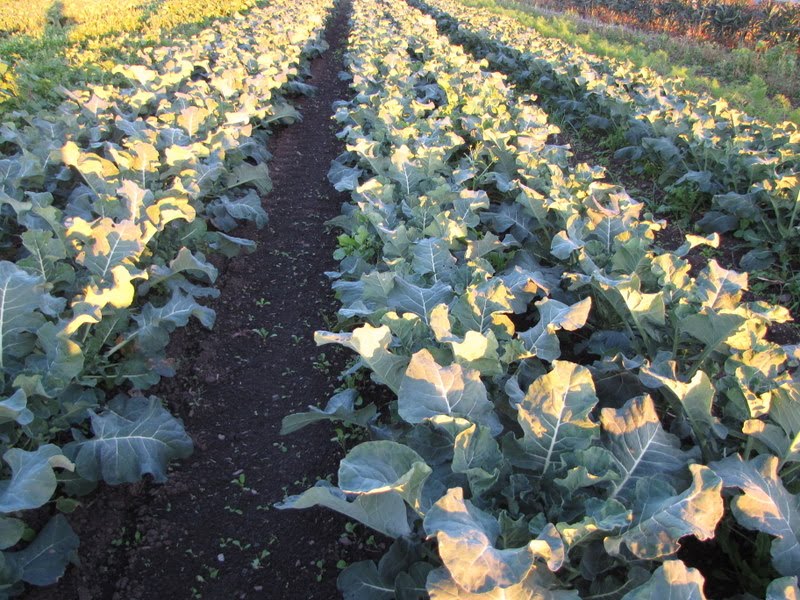
Caption: Weather extremes have stunted the farm’s broccoli crop, placing thousands of plants a few weeks behind schedule. Beautiful plants stand vibrant but with no edible buds in sight.


This week you’re seeing some fall favorites: parsnips and spinach. And we’ve tried to include as much that’s fresh from the field (versus storage crops) while we still have it. A sharp freeze any day now could kill off most of what still stands in our fields.

There are a few classic fall crops that we regret we just aren’t getting right now. Namely, broccoli. And cauliflower. And Brussels sprouts.

Their absence pains us as these are vegetables that we’ve been craving along with many CSA members and that we’ve put a lot of work into having this fall. All of these crops were planted in abundance and right on time late in the summer. Theoretically, they should be at their prime right now. But as soon as they were planted we hit the last of this summer’s extreme hot and dry spells. Two weeks’ worth. None of these crops thrive under such conditions. So they sat there dormant in the fields. The stretches of rain we’ve had haven’t helped either. Ten days without sun isn’t exactly an ideal growing scenario. So we’ve thousands of lusciously green leafy broccoli plants, cauliflower plants and Brussels sprouts without any “buds” to speak of. If we got some nice, consistent weather, maybe they’d bud up in a few weeks. But, basically, they’re well behind schedule, and there’s a good chance they’ll freeze before they come to fruition.

So, we work with what we have. Much to enjoy, just not everything we’d hoped, planned and planted for.


IN THIS WEEK’S SHARE:
1 bunch parsnips
½ pound spinach
14 ounces yellow wax beans
1 bunch fresh, baby onions (green tops edible)
6 ounces mesclun mix (for salad or for quickly wilting in olive oil)
1 bunch parsley
1 bunch Easter egg radish
1 head “freckles” Romaine lettuce (see note)
1 bunch dinosaur or Tuscan kale (or 3/4# sugar snap peas if not in your share 2 weeks ago)

___________________

Freckles Romaine:
The reddish-brown “freckles” on this week’s head lettuce aren’t a sign of disease or frost damage. The speckles are intended with this variety of Romaine lettuce. In a salad, we think they look festive. And for a Romaine, we love how tender this variety of lettuce can be.

____________________
Tip: If you have dill left over from last week, chop and blend with some sour cream, lemon zest and lemon juice and extra-virgin olive oil for a zesty dressing for the spinach (if eaten raw). Or drizzle over a salad of sliced radish and parsley leaves.

_____________________
PARSNIPS are a classic in stews, but they are also terrific roasted on their own. We often make this recipe developed by a friend, Amy Albert, for Fine Cooking magazine.
RECIPE: Crisp Roasted Parsnip Sticks We eat them like fries, sprinkled with a little malt vinegar.

or, add a little local maple sweetness with the following roasted parsnip recipe:

MAPLE-GLAZED ROASTED PARSNIPS
From Free Bird Farm

1 bunch parsnips, cut on a diagonal into 1/2-inch-thick slices
2 tablespoons extra-virgin olive oil
Kosher salt
2 teaspoons finely chopped fresh Italian parsley
1 ½ tablespoons pure maple syrup
1 tablespoon unsalted butter

Heat oven to 400°F. Toss the parsnips with the olive oil and a large pinch of Kosher salt in a bowl. Sprinkle with a large pinch of Kosher salt. Spread parsnips in single layer on rimmed baking sheet.

Roast parsnips 20 minutes. Turn and roast until browned and soft, 15 to 25 minutes longer. Remove the baking sheet from the oven and push the parsnips together into a loose pile with a metal spatula. Drizzle the parsnips with the maple syrup and dot with the butter. Toss to evenly coat with the syrup and butter. Transfer to a plate, sprinkle with the parsley and serve.

_______________________________________
At the farm, we had this for dinner last night, along with some gently crisped shallot slices and narrow strips of bell pepper (from last week's share) sauteed in olive oil. Great with some short-grain brown rice.

Quick Sautéed Spinach with Garlic Chips
From Free Bird Farm

4 peeled cloves garlic, very thinly sliced
3 tablespoons extra-virgin olive oil
½ pound spinach, washed and spun dry in a salad spinner
Kosher salt and freshly squeezed lemon juice to taste

Heat half of the olive oil a heavy, large skillet (we recommend cast iron) over medium heat. Add the garlic slices in a single layer and cook, stirring occasionally, until golden brown. Transfer to a small bowl and set aside.

Add the remaining oil and increase the heat to medium high. Add the spinach and cook, tossing frequently with a pair of tongs, until just wilted, about 3 minutes. Remove from the heat and sprinkle with lemon juice and Kosher salt to taste. Serve immediately with the crisp garlic “chips” sprinkled on top.

Wednesday, October 13, 2010

Share Week #20


We’ve reached that time in the season when the weather really has the final word. We could have a good variety of crops thriving until almost Thanksgiving or it could be pretty much a wrap within the next couple of weeks.

This past weekend we got our first frost, and it was a good zap.

We spent Saturday harvesting like mad—bringing in whatever we knew wouldn’t stand up to Sunday’s early morning frost. Some of this week’s share consists of that final picking.

Saturday was also spent covering those crops most vulnerable to frost, such as green beans and baby lettuce, with a soft, protective agricultural fabric (seen in pic).

The farm is still waterlogged from that unrelenting rain we had up until Thursday. Even in sloped spots, the fields are still wet and muddy. We simply got more rain than the ground could absorb. This makes the harvest extra challenging—because there’s often 2 pounds of thick, heavy mud clinging to the soles of one’s boots. (Those CSA members who made it to this year’s rainy day Open House know a little bit about what we’re talking about.)

We could now use some consistent sun and relative warmth so that the fall plantings that survived all that rain can grow. Nothing has been able to progress or grow in the last couple of weeks, which could short us of harvestable crops in these last couple weeks of the CSA season.

IN THIS WEEK’S SHARE
2 lbs. red potatoes
3 red onions
6 ounces mesclun mix
1 bunch carrots
1 bok choy
6 ounces arugula
1 red leaf lettuce
1 bunch dill
3 yellow onions
last-of-the-season bell peppers or green beans


______________________________
RECIPES:

Dill goes with a lot more than just pickles. Looking for an idea? Here are a couple that go with some of the veggies in this week's share too:

Carrot Soup with Dill PestoFrom Epicurious.com

AND

Creamy Potato Salad with Lemon & DillServes six.

This was adapted from a recipe by Molly Stevens in Fine Cooking magazine. The salad would be niced served over a bed of this week’s red leaf lettuce.

2 pounds unpeeled red potatoes, scrubbed (small potatoes left whole, medium to large ones cut into large chunks)
Kosher salt
¼ cup minced red onion
2 tablespoons chopped fresh dill
1/4 cup heavy cream, well chilled
1/2 cup mayonnaise
1-1/2 teaspoons Dijon mustard
1-1/2 tablespoons fresh lemon juice
2 teaspoons grated lemon zest
Freshly ground pepper

Put the potatoes in a medium saucepan, cover with water by an inch or two, add a large pinch of salt, and bring to a boil. Reduce the heat to medium, partially cover, and cook until the potatoes are tender, about 20 minutes. Test for doneness by spearing a potato with a thin metal skewer. It should penetrate easily into the center of the potato and then slide right out. If the skewer lifts the potato out of the pot when you withdraw it, continue cooking a little longer. Drain the potatoes and let them cool. You can drain them on a cooling rack set over or in your sink, which will avoid squashing the tender potatoes (as often happens with a colander) and also lets the potatoes cool quickly.

When the potatoes are at room temperature, cut them into 3/4-inch chunks and put them in a mixing bowl. Add the onion and fold gently to distribute; set aside.

In a small bowl, whisk the cream until frothy but not at all stiffened. Whisk in the mayonnaise and mustard. Add the lemon juice, zest, 1/2 teaspoon salt, and pepper to taste. Pour the dressing over the salad and fold it in with a rubber spatula. Taste for seasoning. Serve, or cover and chill for up to a day.


A great fall recipe for lunch or a light dinner (maybe with the carrot soup?) that makes use of this week's arugula: Open-Face Brie, Apple, and Arugula Sandwiches

OR

Pasta Salad with Arugula, Feta & Sun-Dried Tomatoes, by Tony Rosenfeld, Finecooking.com

And here's something to try with this week's bok choy...

Salmon "Bulgogi" with Bok Choy and Mushrooms
Bon Appétit | June 2008